Before it became an art form admired in museums, paper cutting was a language spoken by women in rural China — a way to mark births, weddings, harvests, and the turning of the year.
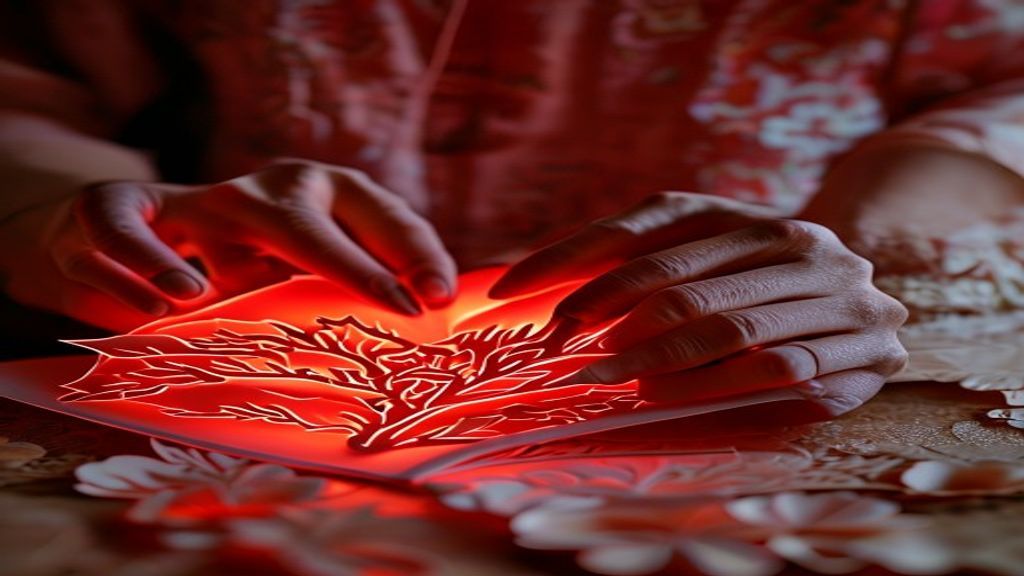
Walk through a village in northern China during the Lunar New Year and you will still see it: red paper cut into flowers, animals, and characters, pressed against window glass so that sunlight filters through the negative space. To outsiders, these decorations are beautiful. To those who grew up with them, they are a code.
From windows to wishes
The origins of Chinese paper cutting, or jianzhi (剪纸), are difficult to pin down. Some historians trace it to the Han dynasty, when paper itself was invented; others argue it emerged later, after paper became affordable enough to cut and discard. What is clear is that by the Tang dynasty, paper cutting had already become a common folk practice across much of China.
In its earliest form, paper cutting was not meant to last. It was made for festivals, pasted on windows and doors, then burned or replaced when the season changed. The impermanence was part of the point: a fresh cut for a fresh year, a red paper blessing to welcome spring and ward off misfortune.
"A window without paper cuts is like a face without eyebrows." — Northern Chinese folk saying
What the scissors say
Like many folk arts, paper cutting developed a visual vocabulary. A single image could carry a meaning that every viewer understood:
- Peony (牡丹): wealth, honor, and a prosperous household
- Fish (鱼): abundance, because the word sounds like "surplus"
- Bat (蝠): good fortune, a homophone for "blessing"
- Double happiness (囍): marriage and union
- Dragon and phoenix: the cosmic balance of yin and yang
These were not arbitrary choices. They were puns, rebuses, and wishes compressed into shape. A gift of paper cuttings at a wedding was not merely decorative; it was a layered message of fertility, prosperity, and family continuity.
Regional voices, same scissors
One of the remarkable things about Chinese paper cutting is how differently it sounds from place to place. In Shaanxi and Hebei, the style tends to be bold and vigorous, with thick lines and exaggerated figures. In the south, especially around Yangzhou, the cuts become delicate and intricate, almost lace-like.
The Yuxian paper cuts of Hebei are famous for their bright colors, dyed after cutting. The Foshan cuts of Guangdong often include gold foil. Each region adapted the craft to local materials, beliefs, and aesthetics, creating distinct dialects of the same visual language.
Why it still matters
Today, paper cutting is recognized by UNESCO as an Intangible Cultural Heritage. Master cutters give demonstrations in museums and cultural centers. Yet the craft's deeper power may still lie in ordinary hands: a grandmother cutting a rabbit for a grandchild's birth year, a teacher preparing window decorations for a classroom, a bride receiving a pair of mandarin ducks as a wedding gift.
In an age of digital images, the slowness of paper cutting feels radical. Each cut is irreversible. There is no undo button, only the next careful slice. That concentration, and the cultural memory carried in every pattern, is what keeps the practice alive.
Try it yourself
You do not need special training to begin. A sheet of red paper, a small pair of sharp scissors, and a simple pattern are enough. Start with a four-fold snowflake-style design, then progress to more open cuts. The goal is not perfection; it is to feel how a flat sheet of paper can suddenly contain a story.